

Who was Armando Brasini, the architect behind the Grand Hotel Plaza
The entrance, the Winter Garden, the bar, the restaurant, the monumental hall: the rooms that define the Grand Hotel Plaza were not always there. In the 1930s, the Roman architect Armando Brasini rebuilt them from scratch, giving the hotel the interior identity it carries to this day.
To understand what you are looking at when you walk through those spaces, you need to know who Brasini was, why his style was so distinctive, and what he was trying to do.
A self-made architect in a city of ancient stones
Brasini was born in Rome on 21 September 1879 into a modest family with no connections in the architectural world. He did not come up through the usual channels. He learned his craft by working on church decorations and studying at the Institute of Fine Arts, developing a direct, hands-on familiarity with ancient Roman and Baroque forms that most of his contemporaries only encountered through textbooks.
That formation shaped everything that followed. Where formally trained architects of his generation were taught to reason from first principles, Brasini reasoned from Rome itself, from its ruins, its churches, its palaces. By the time he established himself independently, he had become one of the most recognisable stylistic voices in the city, sought out precisely for his ability to work with historic fabric rather than against it.
Brasini's architectural style
Brasini's work is best described as eclectic neo-Baroque, rooted in ancient Roman monumental architecture and filtered through the dramatic visual grammar of Giovanni Battista Piranesi, the 18th-century printmaker whose imaginary ruins defined a certain idea of Roman grandeur. The critic Paolo Portoghesi called him "one of the great misfits of twentieth-century architecture," meaning that Brasini followed his own logic at a time when the rest of Europe was moving toward rationalism and functionalism.
His signature elements appear across his projects: marble columns and pilasters, arched vaults with stucco mouldings, surfaces that reward close attention rather than communicating at a glance. He was not reconstructing the past; he was working in a tradition that, to him, was still alive and still capable of producing meaningful space. The Plaza's Winter Garden, with its arched vault and Art Nouveau glass skylight, is exactly that kind of space.
The buildings that defined his reputation
Brasini's most visible work in Rome spans three decades. In the 1920s he designed the Basilica of the Sacred Heart of Mary in Parioli, approved by both Pope Benedict XV and Pope Pius XI, and the sprawling Complesso del Buon Pastore on Via di Bravetta. In the 1930s he completed the INAIL building near the Quirinal Hill, which balances classical monumentality with more contained early-century lines, and the Ponte Flaminio, one of Rome's key bridges over the Tiber.
His range extended well beyond single buildings. He contributed to the Central Museum of the Risorgimento inside the Victor Emmanuel II Monument, designed sets and costumes for early silent films including Theodora (1921) and Quo Vadis (1924), and in 1925–1926 produced the first urban master plan for Tirana, elements of which still survive in Skanderbeg Square's layout and the city's main north–south axis. In 1929 he was appointed a member of the Royal Academy of Italy.
What Brasini built at the Grand Hotel Plaza
The building that houses the Grand Hotel Plaza was originally constructed in 1837 as the palazzo of Count Antonio Lozzano, designed by the architect Antonio Sarti. It became a hotel in the mid-19th century and changed names several times before taking the name Hotel Plaza in 1930. It was around that moment that Armando Brasini was commissioned to carry out a major renovation of the interior.
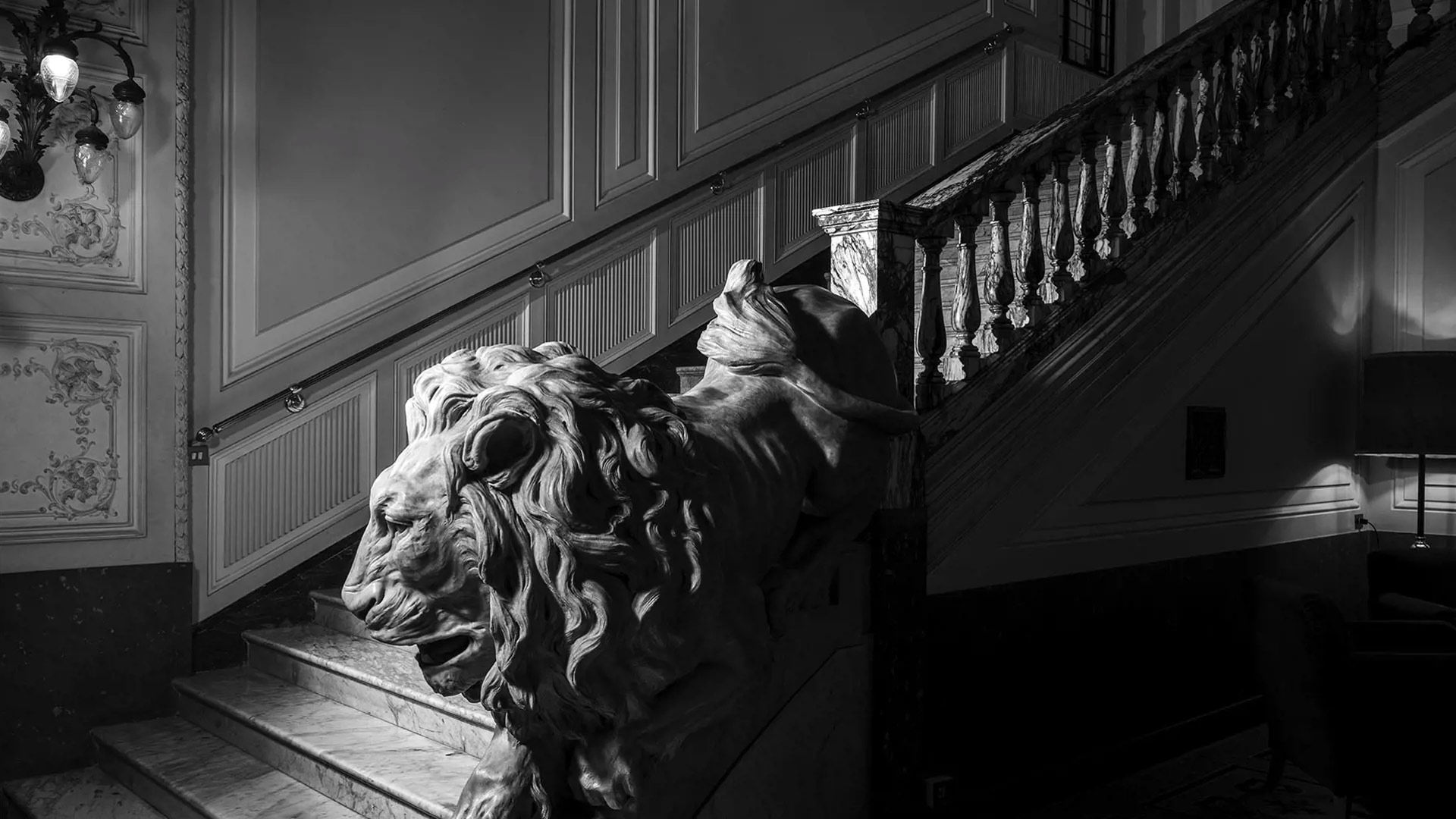
Brasini's intervention was comprehensive. He redesigned the entrance, the Winter Garden (Giardino d'Inverno), the bar, the restaurant, and the monumental hall. The style he chose was drawn directly from ancient Rome: wall pilasters, marble columns and balustrades, surfaces sheathed in precious stone. The Winter Garden, the room that most guests remember, features an arched vault with stucco mouldings and a large skylight with Art Nouveau glass panes, a combination that fills the space with diffused light and gives it a quality somewhere between a Roman atrium and a Baroque church interior.
These are not decorative gestures. They are a coherent architectural argument, made in Brasini's characteristic idiom: that a room should feel permanent, that ornament should carry weight, and that the relationship between materials, proportion, and light should be resolved before anything else.
Why Brasini is less known than his contemporaries
The straightforward answer is timing. Brasini reached his peak during the 1920s and 1930s, just as the architectural mainstream in Europe turned decisively toward modernism. The International Style and Italian rationalism both valued simplicity, standardisation, and the deliberate rejection of historical ornament. Brasini did the opposite and paid for it in critical attention for much of the 20th century.
His association with the Fascist period also complicated his posthumous reputation. Many architects active in that era faced reassessment after 1945, and Brasini was no exception. Yet his style predated Fascism and continued after it, and his work was never ideologically reducible to political context. Robert Venturi, one of the architects who later rehabilitated ornament and historical reference, was among those who recognised Brasini's approach as a coherent position rather than a reactionary one.
A third factor was temperament. Brasini was not a theorist or a polemicist. He did not write manifestos or build a school around his ideas. He built buildings. That focus left him less visible in an architectural history often written through intellectual movements rather than individual bodies of work.
How Brasini's work compares to rationalist contemporaries
Where Italian rationalists like Giuseppe Terragni moved toward stripped classicism and geometric abstraction, Brasini stayed committed to layered decoration and compositional richness. This was less a rejection of modernity than a different answer to the same question every architect in Italy faced: how should new work respond to a city with 2,500 years of built history
A rationalist façade communicates at a glance: clean lines, clear structure, resolved geometry. A Brasini interior, by contrast, rewards sustained attention. The relationships between elements (column to vault, marble to stucco, artificial light to the daylight coming through a glass skylight) accumulate meaning as you spend time with them. That quality, which critics of his era sometimes read as excess, is what gives his spaces a presence that does not diminish with familiarity.
What historians say about his legacy
Brasini's critical standing has improved significantly since the 1970s. The postmodern reassessment of ornament and historical reference gave architectural historians new tools to discuss him on his own terms, rather than judging him against a modernist standard he never claimed to share.
The University of Notre Dame's Rome programme has worked to preserve and catalogue the Brasini papers, a significant archival project that signals his growing scholarly importance. In 2016, he was the subject of comparative analysis alongside Boris Iofan, the Soviet architect responsible for the Palace of the Soviets project, positioning Brasini as a key figure in the tradition of monumental classicism at a moment of intense political and cultural pressure across Europe. The comparison pointed to something long underappreciated: his architecture was making a serious argument about permanence, scale, and the meaning of public space.
What to look for in Brasini's spaces at the Plaza
If you want to read Brasini's work at the Grand Hotel Plaza with a more informed eye, here are five things worth attention.
- The Winter Garden skylight. The Art Nouveau glass panes are not decorative; they are the room's primary light source. Brasini designed the vault and the mouldings to respond to the quality of light coming through them at different times of day.
- The column rhythm. The marble columns in the hall are not evenly spaced by accident. Their rhythm controls how you move through the space and where your eye lands.
- The pilasters on the walls. Wall pilasters are one of Brasini's recurring devices. They give flat surfaces a vertical cadence and connect the wall plane to the architecture of ancient Rome without direct quotation.
- The transition between rooms. Moving from the entrance to the hall to the Winter Garden is an architectural sequence, not just a path between spaces. Notice how the ceiling height, the light, and the material density change at each threshold.
- The overall scale. Brasini designed from the large scale down. Before you focus on any single detail, look at the proportions of the room as a whole: height to width, opening to solid wall. That is where his logic starts.