

What Does "Pizza e Fichi" Mean in Rome?
In a Roman bakery, pizza bianca is the flatbread dressed only with salt and oil and sold by the cut. When figs come into season, many Romans split a piece in half and fill it with the fruit, often adding a slice or two of prosciutto crudo. The snack is called pizza e fichi, and the name has a second life as a saying. When a Roman says "mica pizza e fichi", literally "it's not pizza and figs", the speaker means that something is worth more than it looks. The phrase is built from humble food, because mica derives from the Latin word for a crumb of bread and the fig is the Italian measure of what is worth nothing.
What does "mica pizza e fichi" mean?
Gambero Rosso describes "mica pizza e fichi" as a famous Roman saying which suggests that something is worth more than it seems. Calling something "pizza and figs" places it among the ordinary things of everyday life. The negative turns the comparison around, so a Roman uses the phrase for something that a listener might treat as trivial.
The short form of the saying drops the verb and the word non. The Accademia della Crusca explains that in spoken Italian the non before the verb can fall away in negative sentences, especially with mica or similar adverbs, as in the popular "ho mica soldi", I have no money. "Mica pizza e fichi" follows the same pattern, and "non è mica pizza e fichi" is the full version of the same sentence.
What is the pizza in pizza e fichi?
The pizza of the saying is the plain one, without tomato. Treccani records that in Rome the word names a flatbread of bread dough, baked in the oven and dressed with salt and raw oil, which people eat like bread, often with prosciutto, ricotta or something else in the middle. Romans also call it pizza bianca, white pizza, to tell it apart from pizza rossa, the version dressed with tomato. The De Mauro dictionary adds that pizza bianca is sold by the cut.
Gambero Rosso places pizza e fichi next to pizza e mortazza, pizza bianca with mortadella, among the combinations Romans prefer. The same article describes the bread as fragrant, slightly oily and full of bubbles, with a crispy and flaky crust, and writes that, paired with figs and often with prosciutto crudo, its taste contrasts with the sweetness of the fruit. Treccani gives the word pizza itself a modest origin, with a cautious "perhaps". The word already existed in medieval Latin and may derive from the Old High German bizzo or pizzo, "a mouthful, a piece of bread, a flatbread".
Why do figs stand for something cheap?
Italian uses the fig as a unit of worthlessness in several fixed expressions. Treccani lists "non vale un fico", it isn't worth a fig, and the stronger "un fico secco", a dried fig, both meaning nothing at all. As an example it quotes the writer Ennio Flaiano, who wrote that all the material he kept aside in notebooks and drawers was not worth a fig. Another expression, "fare le nozze coi fichi secchi", to hold a wedding with dried figs, means doing in a mean way something that should be solemn and rich.
Gambero Rosso adds that figs were once called "the bread of the poor", because everyone could get them, and describes pizza bianca in the same terms, as a popular and affordable product. In the saying, the flatbread and the fruit together stand for anything ordinary.
Why does "mica" mean "not at all"?
The first word of the saying has its own food history. According to the Accademia della Crusca, mica derives from the Latin mica, "a crumb of bread", a word attested in Petronius. In Italian it has carried the meaning "not at all" since the Ritmo di Sant'Alessio, a poem composed in the twelfth century. The meaning grew out of negative sentences such as "I don't eat even a crumb", and the word then spread to sentences with any verb. The first edition of the Crusca dictionary registered mica in 1612.
The Crusca adds that mica spread mainly in spoken Italian, while its occurrences in literature are not numerous. The full answer is in the Accademia della Crusca note on mica and manco, in Italian, which also follows the word into French, where mie from the same Latin root survives as an archaic form.
Did the saying start with a Roman snack?
The origin of the saying is less settled than its meaning. Gambero Rosso writes that the combination of pizza and figs later became the famous Roman saying, and connects it to the reputation of figs as food for the poor. An article in Treccani's Atlante magazine, discussing Alessandro Marzo Magno's book Il genio del gusto, gives another reading. It links "mica pizza e fichi" to a complicated mash of fresh and dried fruit with eggs and butter, typical of the Italian Middle Ages, and traces to that dish the pinza, a sweet of north-eastern Italy with a similar name.
Neither text gives a date or a first written record of the saying. The meaning is clear, while the dish behind it may be the Roman pizza bianca or an older fruit preparation that shared the name.
Where can you try pizza e fichi in Rome?
The snack needs a piece of pizza bianca and a few ripe figs, and a morning market in the historic centre has fruit stalls.
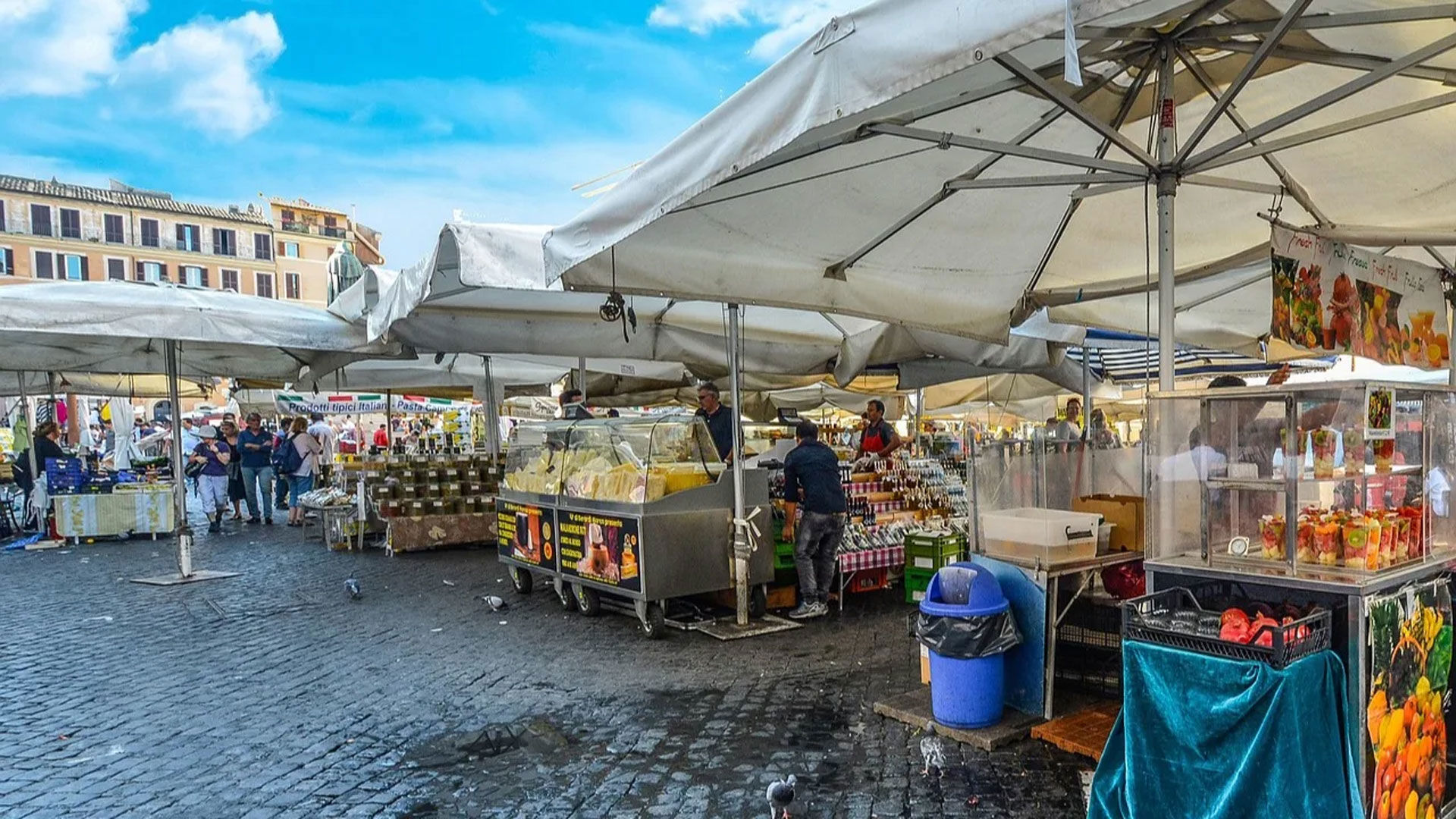
- Visit the market in Campo de' Fiori, which moved there from Piazza Navona in 1869 and traditionally takes place every morning from Monday to Saturday. Its stalls sell fruit and vegetables, flowers, meat, fish and dried fruit, and the statue of Giordano Bruno by Ettore Ferrari stands in the middle of the square. Details are on the Campo de' Fiori page of Turismo Roma.
- Plan around the fruit. Treccani notes that the first figs, called fioroni, ripen from June to July, and the main crop ripens from August to September.
- Ask a bakery that sells pizza bianca by the cut for a piece split in half, then fill it with figs and, if you like, prosciutto crudo.
- For a version without meat, Gambero Rosso suggests ricotta or primosale cheese, and gorgonzola.
To explore the wonders of Rome from a historic hotel, stay at the Grand Hotel Plaza, in the heart of the city centre.