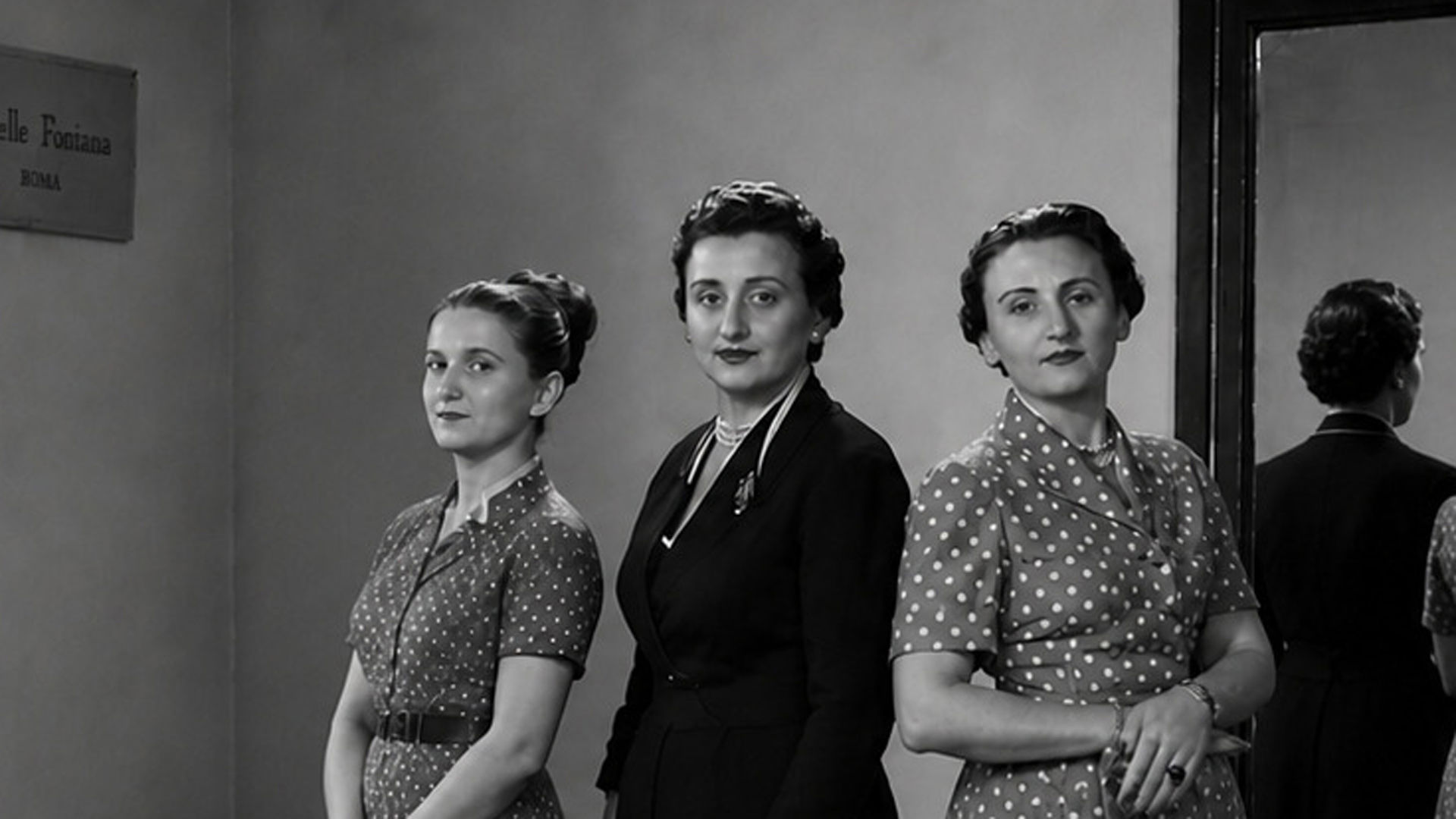


Sorelle Fontana and the Golden Age of Roman Haute Couture
In the years after World War II, three sisters from Traversetolo, near Parma, quietly reshaped Italian fashion. Zoe, Micol, and Giovanna Fontana arrived in Rome with a shared skill and a shared name, and by 1943 the Sorelle Fontana maison was open on Via Liguria, in the center of a city still finding its footing after the war.
Three sisters and a city rebuilding itself
Rome in the late 1940s was damaged and elegant at the same time, exhausted and restless. It was exactly the kind of place where a new idea about beauty could take root. The Fontana sisters understood this. Their atelier became a space where Roman craftsmanship met an international sensibility, where the precision of the needle answered the demands of women who wanted something no department store could offer.
Their work drew from the long tradition of Italian textile artistry while refusing the rigidity of prewar fashion. The cuts were fluid, the embroidery meticulous, the silhouettes built around the body rather than imposed upon it. Word spread quickly, first within the city, then far beyond it.
Hollywood comes to Via Liguria
The turning point arrived on January 27, 1949, when American actress Linda Christian wore a Sorelle Fontana gown for her marriage to Tyrone Power at the church of Santa Francesca Romana, steps from the Colosseum. Press from across the world photographed the wedding. The images that circulated that day showed Rome, and a dress made by three Italian sisters.
What followed was a decade of extraordinary visibility. Elizabeth Taylor, Ava Gardner, Audrey Hepburn, and Grace Kelly all passed through the Via Liguria atelier. Each commission was a statement that Rome had joined the small circle of cities where the most photographed women in the world chose to dress. The Fontana sisters had built the conditions for that recognition.
The making of Italian haute couture
On February 12, 1951, Giovanni Battista Giorgini organized the first collective presentation of Italian fashion at Palazzo Torrigiani in Florence. The Sorelle Fontana were among the founding participants. Those shows established an Italian answer to the French couture calendar, and the Fontana name was part of its architecture from the beginning.
Their contribution went beyond the garments. The sisters helped demonstrate that Italian fashion had its own vocabulary of materials, techniques, and references. The embroidered evening gowns, the ecclesiastical influences reinterpreted in silk and organza, the construction precision that made each piece a record of skilled labor all reflected a conscious artistic position, not an accident of style.
The archive and what it holds
The maison closed its couture operations in 1992, the year the founding generation stepped back. What remained was an archive of extraordinary depth, with original sketches, garments, correspondence, photographs, and records of commissions spanning four decades of international fashion. That material needed both a guardian and a place. The Grand Hotel Plaza on Via del Corso became that place, where archival garments and original sketches remain on display, giving the maison daily visibility in the historic center of the city where the brand was born.
For a couture house whose story is inseparable from Rome, that continuity of place is the most accurate way to keep the name where it has always belonged.
Two screen portraits worth watching
For anyone who wants to go deeper into the Fontana story, two Italian productions offer very different but equally rewarding perspectives. The 2011 RAI miniseries Atelier Fontana, Le sorelle della moda, directed by Riccardo Milani, reconstructs the sisters' journey from a small sartoria in Emilia to the heights of Roman couture, with Alessandra Mastronardi, Anna Valle, and Federica De Cola in the lead roles. The 2024 documentary Illuminate, Sorelle Fontana, directed by Luca Brignone and broadcast on Rai 3, takes a different approach, tracing the sisters' legacy through archival material and contemporary reflection. Together, the two titles cover the full arc of the Fontana story, from its origins to its place in Italian cultural memory.