

How a Copying Mistake Gave Us the Word "Obsidian"
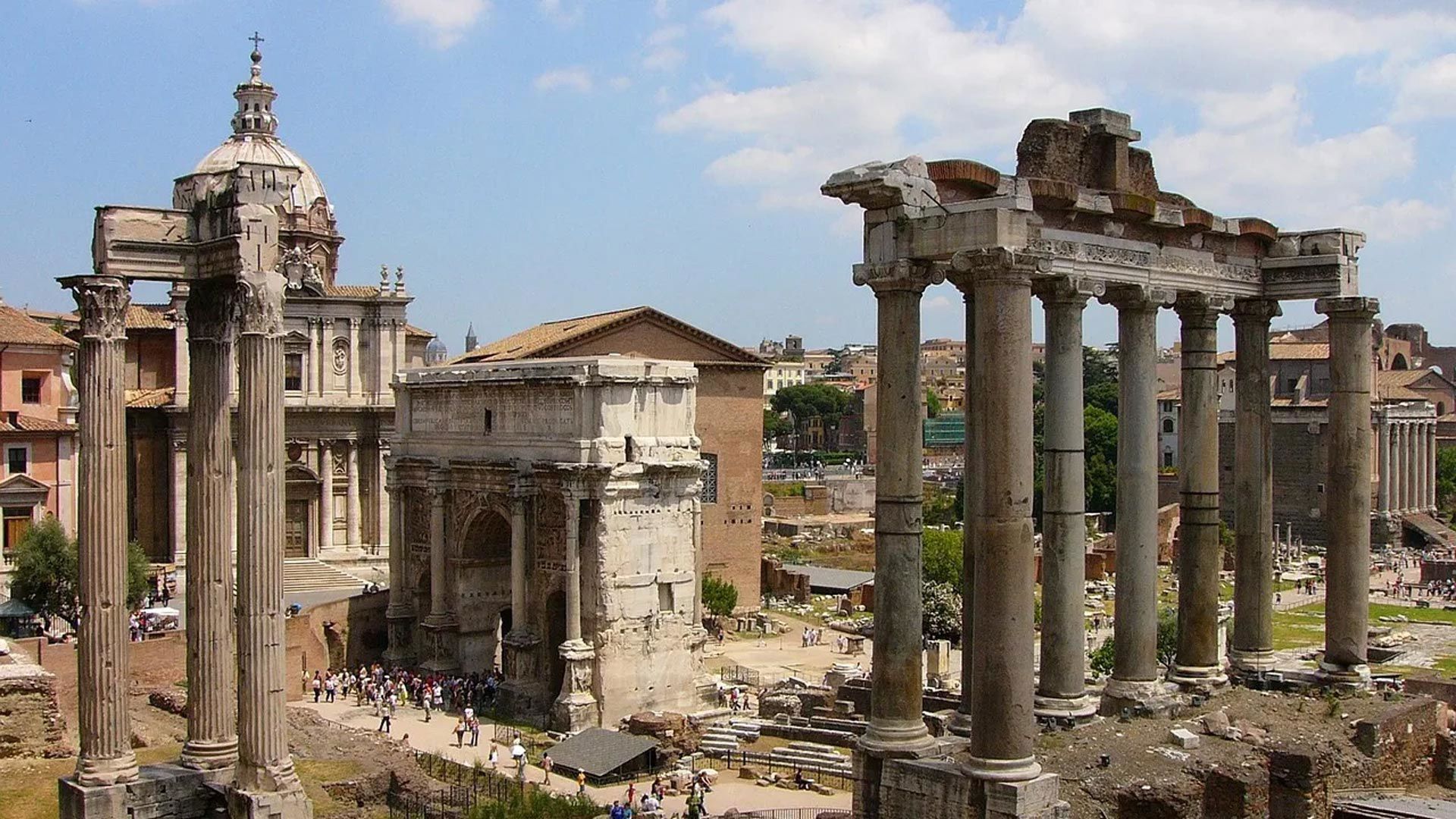
On the edge of the Roman Forum, at the foot of the Capitoline Hill, a mound of rubble lies below the arched loggia of the Tabularium. It is the foundation of the Temple of Concord, and nothing else of the building survives. Pliny the Elder writes that the emperor Augustus dedicated four elephants of a black stone in this temple, as a marvel. Pliny named the stone after a man called Obsius, and the English word obsidian carries an extra syllable because early editions of his text spelled that name wrong.
Who was Obsius, and what did he find?
Pliny describes the stone in the thirty-sixth book of his Natural History, in the chapter on glass. He counts the obsiana among the kinds of glass because they look like a stone that Obsius found in Ethiopia. The stone is very dark and sometimes translucent, and a mirror made of it and set into a wall reflects only the shadow of whatever stands in front of it. The passage says nothing else about Obsius. You can read the chapter in Latin, sections 196 to 198, in the text of Book 36 published by LacusCurtius.
The Lewis and Short Latin dictionary lists Obsius as a Roman surname and gives the adjective obsianus the meaning "belonging to Obsius". The lapis obsianus was the stone of Obsius, named after the man who found it.
Where did the extra syllable come from?
The extra syllable comes from the printed editions of Pliny. According to the 1911 Encyclopaedia Britannica, medieval writers called a similar rock obsianus, and the early printed editions of Pliny wrongly named the finder Obsidius and the rock obsidianus. The Lewis and Short dictionary records the same older readings, Obsidius and Obsidianus, and states that the modern name of the stone comes from them. Dictionary.com describes Obsidianus as a printer's error for Obsianus.
Later editors restored the name in the Latin text. The English translation by John Bostock and H. T. Riley notes that the editor Sillig corrected the old reading Obsidius to Obsius. Modern languages kept the longer form. Treccani traces the Italian ossidiana to the French obsidienne, in older French obsidiane, and from there to the Latin obsidiana, which it calls an erroneous reading in editions of Pliny for obsiana.
The two spellings still stand side by side in the Latin text that LacusCurtius publishes, which follows the Teubner edition. The sentences on glass and on the statue of Menelaus read obsiana and obsianam, while the sentence on the elephants of Augustus reads obsidianos.
What did the Romans make from obsidian?
Pliny writes that many people cut gems from the stone, and that he had seen solid statues of the deified Augustus made of it, of considerable thickness. Tiberius sent back to the city of Heliopolis, for its religious ceremonies, an obsidian image of Menelaus found in the estate of a former prefect of Egypt. From that statue Pliny concludes that the material had been in use for longer than his contemporaries thought, since they confused it with glass because of the resemblance.
Pliny reports, on the authority of the Greek writer Xenocrates, that the stone formed in India, in Samnium in Italy and in Spain along the Ocean coast. In the same passage he mentions an artificial version, made of coloured glass for tableware and called by the same name. According to the 1911 Britannica, the Greeks and Romans worked obsidian as a gemstone, and because it was so often imitated in glass, eighteenth-century gem collectors called every antique paste an "obsidian".
What stood in the Temple of Concord?
Augustus placed his elephants in a temple with a long political history. According to tradition, the temple was vowed in 367 BC to mark the reconciliation between patricians and plebeians, and it was rebuilt in 121 BC after the murder of Gracchus. Tiberius restored it during the reign of Augustus and probably rededicated it in AD 12, with lavish marble and carved decoration. The cella was almost twice as wide as it was deep, because the temple had to fit against the Tabularium.
The temple held so many Greek sculptures and paintings that it seems to have worked as a museum, and the Senate met there, especially in times of civil unrest. Pliny's passage gives no size for the four obsidian elephants and does not say what became of them.
What does obsidian mean to a geologist today?
The misspelled name is now a technical term. In petrography, Treccani explains, obsidian or volcanic glass is any recent eruptive rock made almost entirely of a glassy paste, with few or no distinct minerals. The stone splits easily into sharp edges, so people in the late Neolithic used it widely for tools and weapons and exported it from the areas richest in it. In Italy obsidian is common on the island of Lipari and on Etna.
How can you see the Temple of Concord today?
The remains of the temple sit inside the archaeological area of the Roman Forum, managed by the Parco archeologico del Colosseo.
- The Roman Forum entrance is at Largo della Salara Vecchia 5/6, reached by metro line B at the Colosseo stop or by buses 51, 75, 81, 85, 87 and 118.
- Inside the Forum, look for the foundation of the temple at the foot of the Capitoline Hill, under the arches of the Tabularium.
- Opening hours and tickets are on the official page of the Parco archeologico del Colosseo.
- The Forum has an info point, audio guides, toilets and a lift.
To explore the wonders of Rome from a historic hotel, stay at the Grand Hotel Plaza, in the heart of the city centre.